this study looked at MRI scans from people both before and after the covid-19 pandemic began.
they compared two main groups:
• people who had had two MRI scans before March 2020
• people who had one MRI scan before March 2020, and one after the pandemic began (February 2021 or later)
they used 15,334 MRI scans from "healthy middle-aged and older" participants to create a "brain age prediction model" that is able to identify how old a brain looks
this pre-covid scan data came from the UK Biobank study, which has been following 500,000 participants who were recruited in 2006-2010 to measure long-term health outcomes
the study excludes scans from:
• participants with unusual findings in their first scan
• anyone with the following chronic illnesses: ischemic heart disease, hypertensive diseases, stroke, COPD, chronic kidney disease, dementia, parkinsonism, multiple sclerosis, diabetes, cirrhosis, osteoarthritis, osteoporosis, schizophrenia, depression, bipolar disorder, cancer, fibrosis
• anyone who developed a health condition after the first scan
• the average age of participants was 62.6 years, with most participants between 50 and 75 years old
• tested both grey matter and white matter
• only used scans that were taken at least two years apart
here is a chart that may or may not make it more clear:
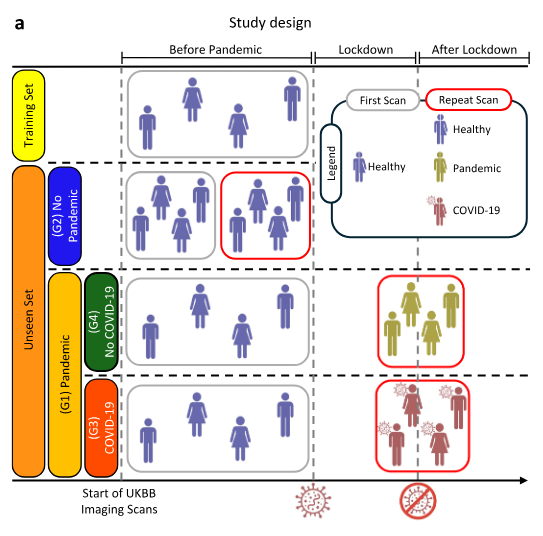
the top row, "training set", is the collection of pre-pandemic healthy brain scans they used to train their neuroimaging model about how brains look as they age.
below that are three groups:
G2 (blue): both scans before the pandemic (how does a brain normally age?)
G4 (green): one healthy scan before the pandemic, and repeat scan after lockdown: people who were not infected with covid
G3 (orangered): one healthy scan before the pandemic, and repeat scan after lockdown: people who DID get covid
what did they find?
• brains that lived through the pandemic had a measurably higher difference between apparent brain age and chronological age
(to the brain prediction model, they had changed more than they should)
• there is no significant visible difference in brain changes (as measured by MRI) between those who had covid and those who did not
• however, participants who had covid did perform more poorly in post-lockdown cognitive performance tests
• the accelerated ageing was more pronounced in older participants
• male participants who lived through lockdown had a 33% higher rate of ageing than female participants
• participants were categorized participants by age and sex, but the study also found that a number of socio-demographic factors (income, employment, housing, general physical health, education) can also influence brain ageing.
so it looks like living through lockdown and the start of the pandemic aged people's brains faster than they would normally, at least for middle-aged and older people in the UK.
can this be applied to the general population? great question.